Comment on Sports Broadcasting Practices and Marketplace Developments
Today, I filed a comment in response to the Federal Communication Commission’s request for commentary on the sports media marketplace and how changes have impacted broadcasters and consumers.
VIA ELECTRONIC FILING
Media Bureau
Federal Communications Commission
45 L Street NE
Washington, DC 20554
Re: SPORTS BROADCASTING PRACTICES AND MARKETPLACE DEVELOPMENTS; MB Docket No. 26-45
Dear Mr. Guo:
On behalf of The Bull Moose Project, I write to urge the FCC to take action on the “blackout” policies adopted by most major national sporting organizations in the United States. The current rules governing sports broadcasting were not tethered in the 1940s, when national televised broadcasts first took off. They are not tethered to the 1960s, when the first American football contracts were signed with television studios. Nor are they tethered to the 1990s, when cable television first emerged. And of course, they are not in any way made for the current fractured media landscape.
They are instead united from any sense of time, community, or place. A mish-mash of rules and regulations accumulated over the past seven decades, they are not just a nuisance: they are actively destroying American sports. The FCC should help reinforce the notion that local fans should be able to easily watch local teams on local TV.
The center of these problems is the “blackout” rule, which holds that a team’s games cannot be broadcast in that team’s region by anyone but a specific local channel. There are a few exceptions, such as games which can be explicitly broadcast by national teams, but they are rare. The rule was adopted for two reasons: to drive viewers to a “local” channel and to get fans to drive to stadiums to watch games in-person.
This has resulted in a fracturing of the media ecosystem. When it was adopted in the 1960s, a given channel having the rights to broadcast did not cause difficulty for viewers, as it simply meant changing the channel. But with the advent of cable, those “local” broadcasts were usually picked up by cable packages, meaning that without the cable package, most fans could not watch their team’s games.
The absurdity of this is illustrated by the plight of Iowa baseball fans. The state of Iowa, though it hosts no Major League Baseball teams of its own, is surrounded by a plethora: the Chicago Cubs, the Chicago White Sox, the St. Louis Cardinals, the Milwaukee Brewers, the Minnesota Twins, and the Kansas City Royals.
The entire state of Iowa is blacked out from all six of them. Whenever those teams are playing, Iowans cannot turn their TVs on to watch unless they want to get specific packages, often from entirely different cable providers. Some teams, like the Brewers, are not available in central Iowa at all. If you’re a united sports household, this is frustrating; if you and your spouse root for different teams, it genuinely becomes financially unfeasible to continue to watch.
Other states have similarly crossed-over blackout policies, as seen in the map below:
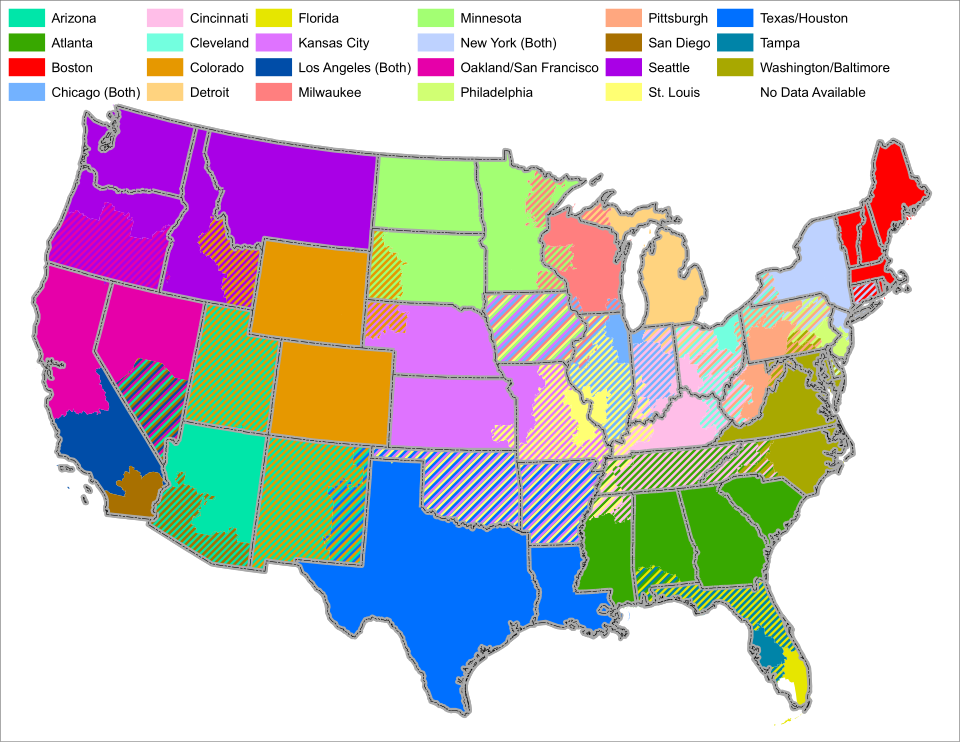
Credit: I, Braindrain0000, Wikimedia
If you live in Des Moines, traveling to each of the stadiums is a major endeavor: the shortest trip is to see the Kansas City Royals, coming in at just under three hours. The longest is to the two Chicago clubs, which take just over five hours. No trip is remotely feasible for families to undertake regularly, and it is difficult to see how this spurs mass travel to Chicago.
The blackouts are even more patently absurd when one considers states like Alaska and Hawaii. Both states are blacked out from their nearest teams. Alaskans are blacked out from viewing Seattle Mariners games (a 37 hour drive), whereas Hawaii is blacked out from five teams: the Los Angeles Dodgers, the Athletics, the Seattle Mariners, the San Francisco Giants, the San Diego Padres, the Los Angeles Angels. Obviously, to see any of those from the Aloha State, one must procure game tickets and plane tickets.
And of course, a given team does not play alone: they square off with others. This results in vast swathes of the country being unable to watch multiple MLB games; on a given day, it is possible for Iowans to not be able to watch a majority of games being played. These inane rules have not inspired Hawaiians to take flights to the mainland to watch their teams, nor has it spurred people en masse to watch cable.
Even individuals in relatively compact areas have difficulty watching their preferred games. Last year, local media had to explain to Braves fans how to watch Braves on “on Gray,” but even that explanation included telling viewers to screenshot a confusing map of channels – all of which had only 15 regular season games (there are 162 games in the regular season; it was left unclear how to watch the other 147).
These rules have not encouraged fans to charge into the breach and purchase a variety of programs. Instead, they have caused fans to simply give up watching baseball entirely. The collapse has been stark. In 1968, 57 percent of all households with a television watched the World Series. Last year, the number was 19 percent. Many have reacted to this by commenting on baseball’s slow, relatively low-scoring nature, as contrasted with the aggression of American football. But this belies belief: sports like soccer and Formula 1, which are often slower-paced or lower scoring than baseball, have been rocketing up in viewership.
The reason for the collapse is obvious: the rise of cable television and the inability for people to watch. In the late 1980s, the World Series was still regularly breaking the 40 percent mark; in 1986, 46 percent of households tuned in. But as cable became popular, that number dwindled. In the early 1990s, viewership was still healthy, with 39 percent tuning in in 1991. But once cable became ensconced, it plummeted, and never reached the 30 percent mark again. By 2000, the mid-to-low 20s was the norm. As of 2025, the World Series has not reached twenty percent since 2017, and it dropped as low as 12 percent – its lowest ever – in 2020, a year in which Americans were confined to their homes due to COVID-19.
The atomization of American culture has not affected all sports. American Football, which ended its blackout policy in 2014, has – in contrast – had no such collapse in viewership, even as American culture has atomized. In fact, it has continued to grow in support; the previous two Super Bowls were the most-watched ever.
It does not always behoove the government to save all institutions at any cost. Technological progress, changing tastes, and changing times can cause interests to fade over time. But sports such as America’s Pastime have not naturally gotten less popular – they are simply being killed off.
This has a deleterious effect on American communities. Children who have easy access to viewing sports from an early age want to then play those sports themselves.
There are easy ways for the FCC to intervene without affecting rights disputes.
For starters, the organization should recognize local sports access as a public interest priority, as it contributes both to community engagement – on and off the field – and because it supports the financial sustainability of local broadcasters.
They should also begin to gather information about how blackouts actually affect individual fans, communities, and the teams themselves. Much of the conversations around blackouts is driven by fans piecing together just how to watch their own games. But the FCC has the power to gather together the whole picture. Such information gathering should include how sports rights deals affect local availability of games, including exclusivity provisions, blackout restrictions, and limits on local simulcasts.
This information could hopefully then be used by Congress, down the line, for legislative fixes. For the time being, the FCC should have a clear policy goal in mind: protect local access by working to ensure that local teams have their games made available freely over-the-air in the home markets of the participating teams, even if those same games are streamed nationwide.
The future of American sports, and American communities, could well be at stake.
Sincerely,
Anthony J. Constantini
Policy Analyst
The Bull Moose Project
Washington, DC